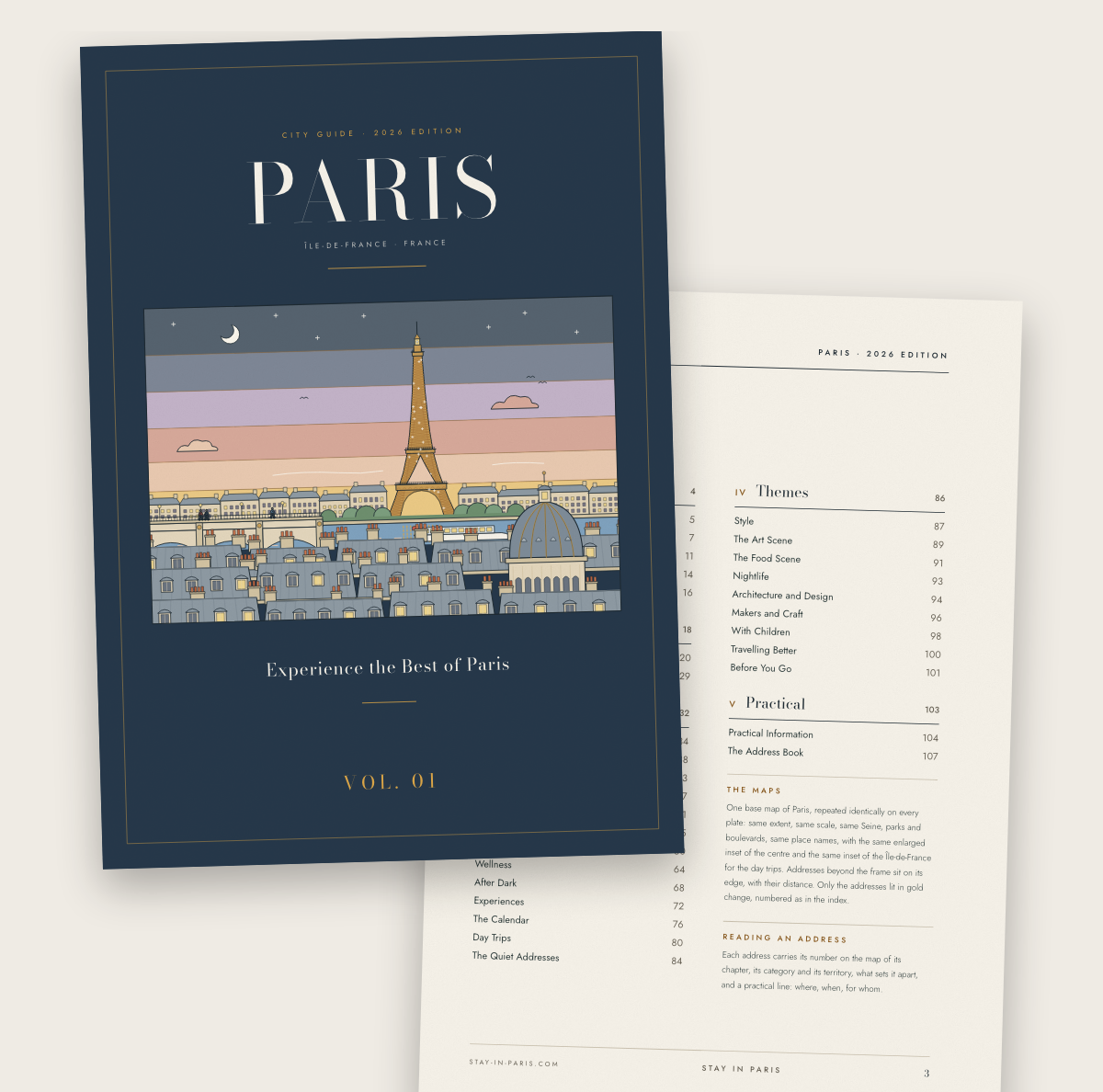
The Paris City Guide, 2026 edition, is out. It runs to 109 plates and does one thing: it reads the city territory by territory, then lists the 102 addresses that justify a stay, each one numbered, placed on a map and given the reason it is in the book.
Here is what is inside, and how to use it before you book a room.
Six territories, and who each one suits
Inside the Périphérique, Paris measures roughly ten kilometres across, and the guide takes that seriously: walking first, the Métro second, the car last. Where you sleep therefore decides most of the trip. The territory chapters open the book and say, for each district, who it suits and what to do there.
The largest share of the addresses, 28, sits in Louvre, Palais-Royal and Place Vendôme, the royal Paris laid out to be looked at, which the guide gives to a first visit. Saint-Germain-des-Prés and the Faubourg Saint-Germain follow with 16, the Left Bank of books, galleries and the townhouses of the 7th. The Golden Triangle and Trocadéro and the 16th have 14 each: the first for the couture houses and the palace hotels a short walk from the Seine, the second for repeat visitors and families who want wide side streets. Le Marais has 9 and South Pigalle and Montmartre 3. Twelve more addresses are elsewhere in Paris, and six are day trips out of the city.
Twenty maps on one base
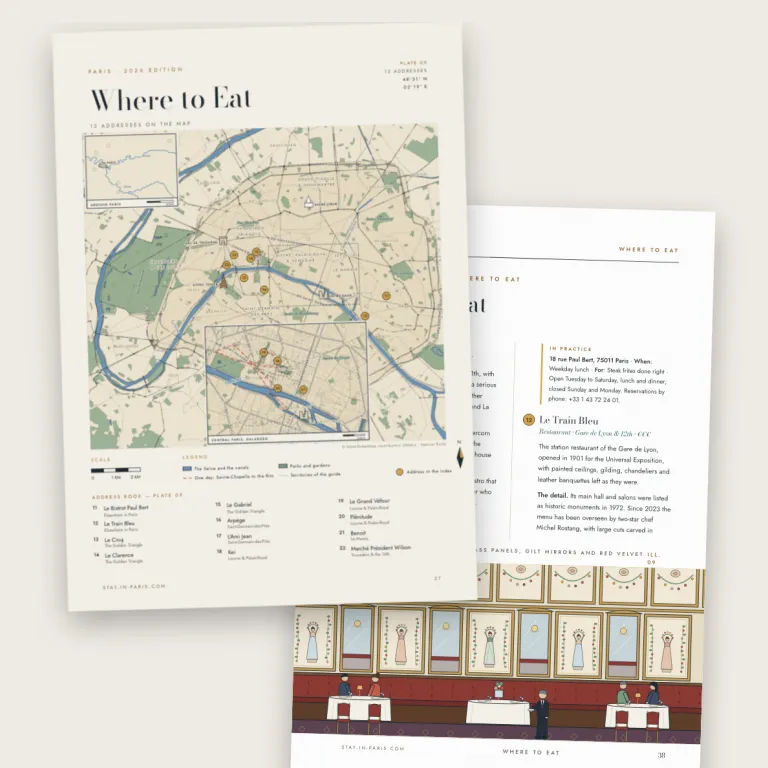
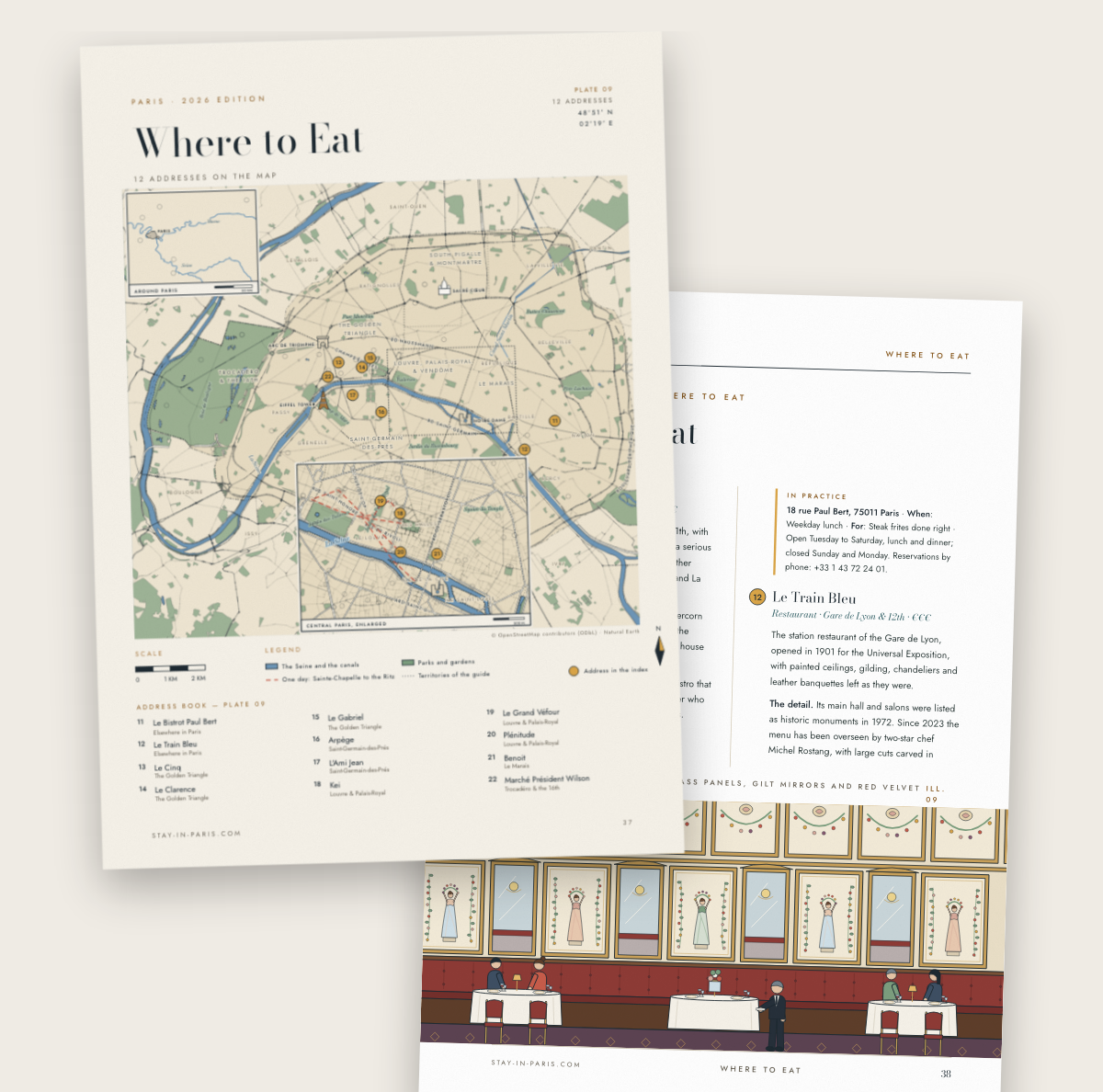
Every map in the guide is drawn on the same base map of Paris: same extent, same scale, same Seine, parks and boulevards, with an enlarged inset of the centre and an inset of the Île-de-France for the day trips. From one chapter to the next, only the addresses lit in gold change. Lay the Where to Eat plate next to the Where to Stay plate and you see at once which tables are a walk from which hotel.
Thirteen chapters of addresses
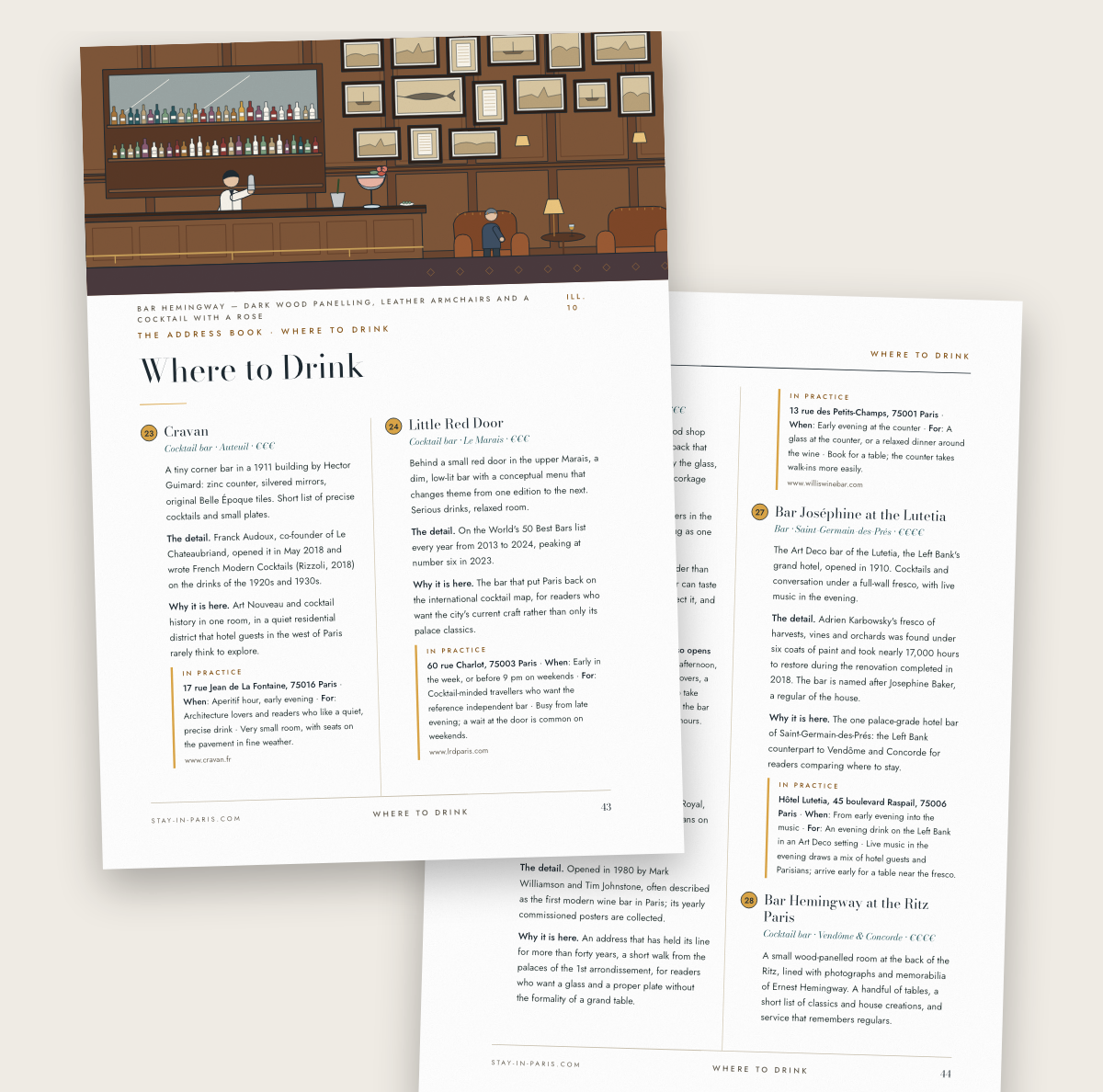
Where to Stay opens the address book with 10 hotels, from Le Bristol Paris and its formal garden to Le Grand Mazarin, the Paris house of Maisons Pariente opened in 2022 near the Hôtel de Ville. Where to Eat has 12 tables, from Arpège, where Alain Passard cooks from his own kitchen gardens, to Le Train Bleu, the station restaurant of the Gare de Lyon, opened in 1901 for the Universal Exposition. Where to Drink has 8 bars, Bar Hemingway at the Ritz Paris and Little Red Door among them.
Then come Coffee and Early Hours (6), Shopping (10, from Charvet to Deyrolle), Culture and Heritage (10, from the Sainte-Chapelle to the Bourse de Commerce), Outdoors (8), Wellness (5), After Dark (6), Experiences (8, including an evening embroidery class at École Lesage), The Calendar (8 dates, from Haute Couture Week to Roland-Garros), Day Trips (6, from Versailles to Reims and Maison Ruinart) and The Quiet Addresses (5), kept for readers who already know the city.
Why each address is there
Each entry carries its number, its category and its territory, what sets it apart, a line headed "Why it is here", and a practical block: where, when, for whom. Cravan, a corner bar in a 1911 building by Hector Guimard in Auteuil, is in the book because it puts Art Nouveau and cocktail history in one room, in a district that hotel guests in the west of Paris rarely think to explore. Le Bristol is there as the classic reference for a first luxury stay, with the advice to book its restaurant separately from the room, several weeks ahead.
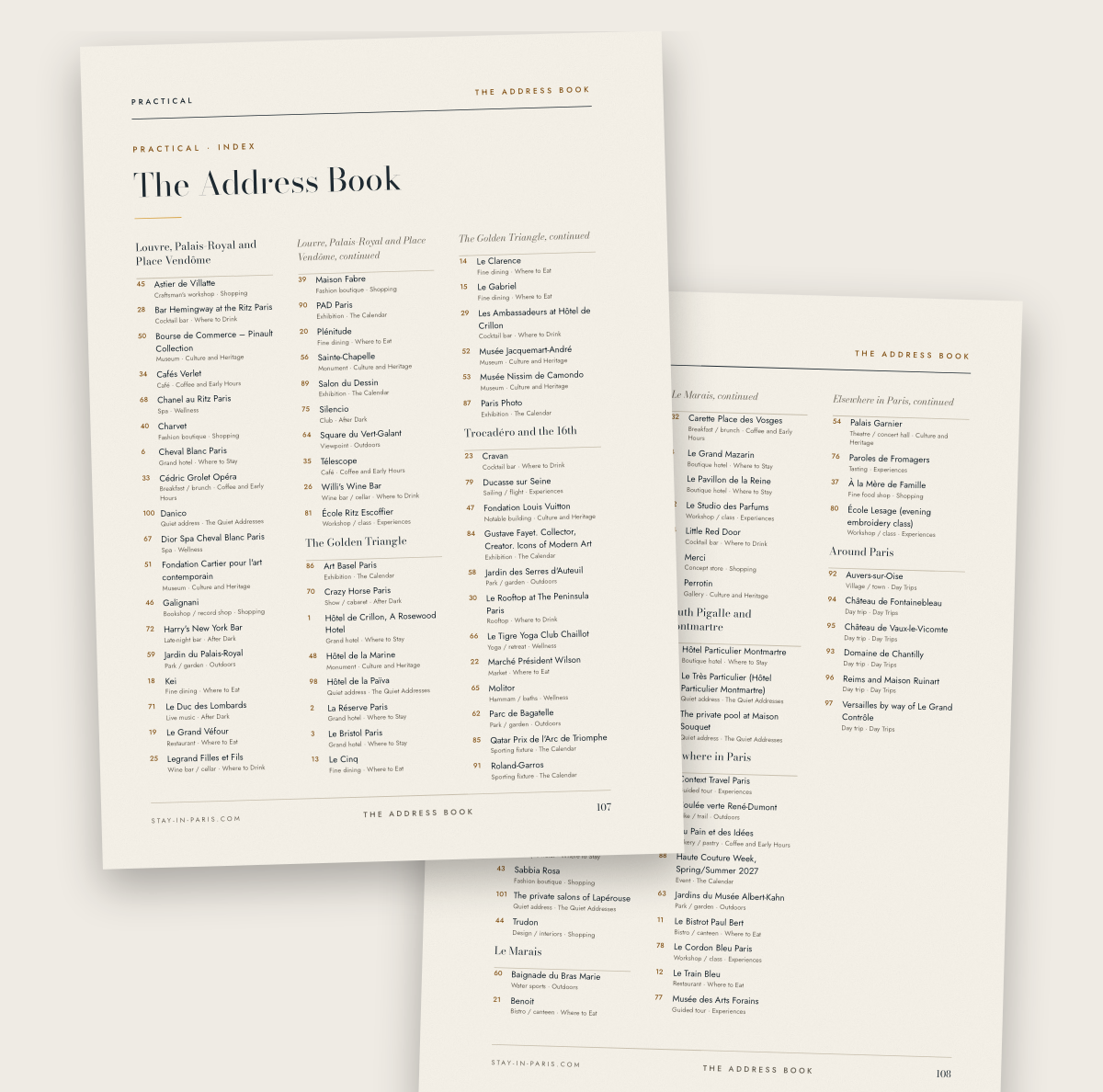
The guide closes on The Address Book, an index of all 102 addresses sorted by territory, so a reader staying in the Marais can see in one column everything within reach.
Three itineraries that chain together
The itineraries are built only from addresses in the guide and set to the days they actually open. The one-day route crosses the Right Bank on foot, from the first timed entry at the Sainte-Chapelle to the Ritz, and runs Wednesday to Friday because several of its stops close on the other days. The three-day route repeats it as its first day, then gives a day to the Left Bank, from a loaf at Poilâne to the Musée Rodin at opening, and a day to the galleries. The five-day route adds two more days, starting with Monceau and the Golden Triangle, from the Musée Nissim de Camondo to the Musée Jacquemart-André.
And around the addresses
The opening chapters cover the spirit of the place, ten facts, when to go, getting there and around, and local codes. On timing, the guide describes four cities in one year: the fashion city of early spring and late September, the half-empty city of August, the art-fair city of October and November, and the quiet city of January. Nine themes follow, from style and the art scene to architecture, makers and travelling with children, then two practical chapters.
The guide is free and opens in the browser, with nothing to install. Its page, just below, gives access to the 2026 edition.